What does the Protect College Sports Act of 2026 mean for my NIL deals right now?
Last week, a landmark bipartisan bill landed in the U.S. Senate. The Protect College Sports Act of 2026 (“PCSA”), sponsored by Sen. Ted Cruz (R-TX) and Sen. Maria Cantwell (D-WA), is the most significant federal attempt to regulate college athletics in history.
Our previous post broke down the full legislation. This post answers the question athletes are actually asking:
What does the PCSA mean for my NIL deals right now?
Here is a clear, practical breakdown of exactly how this bill, if passed, changes the NIL landscape for every college athlete in America.
First: Is This Law Yet?
No. The PCSA was introduced in the Senate on May 27, 2026. It has not passed. It must clear the full Senate with 60 votes, pass the House, and be signed into law before it takes effect.
That said, this bill is further along than any college sports legislation in history. It has bipartisan Senate Commerce Committee backing, conference support, and growing athletic department momentum. The smart move is to understand it now, not after it passes.
What the PCSA Means for Your NIL Deals
1. You Still Have the Right to Earn NIL, and It Is Now Protected by Federal Law
The PCSA does not take NIL away. In fact, it does the opposite: it codifies your right to earn NIL compensation at the federal level for the first time.
Under the bill, no school, conference, or athletic association can strip your eligibility, reduce your scholarship, or cut your institutional support because you signed an NIL deal. That protection — which today relies on a patchwork of state laws, becomes a federal guarantee.
For athletes, this is a meaningful upgrade. It creates a legal floor beneath your NIL rights that no state, school, or association can undercut.
2. Any NIL Deal Worth More Than $600 Must Be Disclosed Within 30 Days
This is one of the most practical changes that affects athletes immediately.
Under the PCSA, if you sign an NIL deal valued at more than $600, you are required to report it to a federal database within 30 days. The reported data is anonymized to protect your privacy, but the disclosure is mandatory.
What this means for you:
Keep detailed records of every NIL deal you sign, amount, date, terms, and compensation.
Work with your agent, family, or advisor to track reporting deadlines from the moment a deal is signed.
Understand that athletic associations, and potentially the NCAA, will have access to this data to evaluate whether deals meet "fair market value" standards.
Deals that appear designed to evade the revenue-sharing cap or disguise pay-for-play arrangements will be flagged for review.
If you are already earning NIL income, now is the time to get organized. Messy recordkeeping becomes a compliance problem under this framework.
3. Your NIL Agent Fees Are Capped at 5 Percent
One of the clearest wins for athletes in the PCSA is agent fee regulation.
Right now, there is no federal cap on what an agent can charge a college athlete. Some agents have been charging double-digit commissions, taking far more than the industry standard. The PCSA changes that by capping NIL agent fees at 5 percent.
Additionally, agents must register with a state before they can legally represent a college athlete. The bill also prohibits agents from misrepresenting NIL deals to convince athletes to enroll or transfer to specific schools.
What this means for you:
If you have a current agent charging more than 5 percent, understand that this cap would apply once the bill is enacted.
Any agent who misrepresents a deal to steer your recruiting or transfer decision could face legal consequences.
You gain a private right of action, meaning you can take an unscrupulous agent to court without being forced into arbitration.
This is a significant protection for athletes who have been exploited by bad actors in the NIL ecosystem. Always review your agent agreements carefully and know what you are paying for.
4. Collective NIL Deals Face Stricter Scrutiny
This is where things get complicated, and where athletes need to pay close attention.
Booster collectives have been one of the primary vehicles for supplementing athlete pay beyond the $20.5 million annual revenue-sharing cap. The PCSA takes direct aim at this. Under the bill, collectives associated with institutions cannot make NIL payments that do not meet standards for a legitimate, market-value deal.
Deals that are structured as NIL but function as recruiting inducements, retention bonuses, or ways to circumvent the revenue-sharing cap will be prohibited and subject to enforcement.
What this means for you:
Collective NIL deals are not going away , but they will face much greater scrutiny than they do today.
Deals that were previously structured loosely to move around the cap may no longer be permissible.
An anonymous NIL market database will be created to establish what "fair market value" looks like for different types of deals, which means enforcement bodies will have real data to compare your deal against.
If a collective deal is flagged or blocked, you may have limited ability to appeal. Understand the compliance landscape before you sign.
The PCSA does not eliminate collective NIL. It eliminates disguised pay-for-play through collectives. Authentic, market-value NIL agreements remain fully permissible.
5. Your Scholarship Is Guaranteed for 10 Years, In Federal Law
For the first time in college sports history, the PCSA would federally mandate that Division I schools guarantee scholarships for 10 years after an athlete's last season — regardless of athletic performance, injury, illness, or roster decisions.
Schools also could not reduce or revoke scholarships based on how you perform on the field or court.
What this means for you:
If you are injured and cannot compete, your scholarship cannot be pulled.
If a new coaching staff takes over and wants to clear roster space, they cannot cut your scholarship.
You retain access to your degree for a full decade after your playing career ends, even if life or injury interrupted your path to graduation.
This is one of the strongest athlete protections in the bill and one that has broad support across the political spectrum.
6. Medical Coverage Becomes a School Obligation
The PCSA requires Division I schools to cover out-of-pocket medical costs for sports-related injuries. This is a major shift from the current environment, where coverage varies significantly by institution.
If you are currently negotiating or reviewing any agreement with your school, this provision, if passed, establishes a federal minimum for what medical coverage must look like.
7. The Transfer Portal Gets More Restrictive
While not directly an NIL provision, transfer portal changes will reshape how NIL and recruiting connect.
The PCSA moves toward a single, unrestricted transfer window per year. That means the strategy of entering the portal as leverage for a better NIL offer, and then withdrawing, becomes significantly harder to execute. Transfer decisions carry greater weight, and the tactical use of the portal as a negotiating tool will be curtailed.
If you are currently using transfer portal activity as part of your NIL strategy, the window for that approach may be closing.
The One Thing Every Athlete Should Do Right Now
Whether the PCSA passes this year or not, it signals the clear direction of where college athletics is heading: toward a more regulated, more transparent, and more federally accountable NIL environment.
The athletes who will thrive in that environment are not the ones scrambling to react after the rules change. They are the ones who have built authentic brands, maintained clean deal structures, worked with trustworthy advisors, and treated their NIL like the professional asset it is.
The era of loosely structured collective deals, uncapped agent fees, and state-by-state patchwork rules is ending. The athletes who are prepared for what comes next will not just survive the transition, they will lead it.
Key PCSA NIL Provisions: Quick Reference
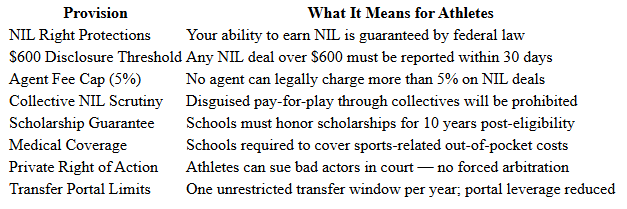
We will continue tracking the PCSA as it moves through Congress and break down every development that affects athletes and families. Follow Pannell Sports Group for updates.
Sources & Further Reading
Tags: Protect College Sports Act, NIL deals 2026, college athlete NIL rights, NIL agent fees, NIL disclosure rules, booster collectives NIL, PCSA college sports, college athlete scholarships, NIL federal law, college sports reform
This blog post is intended for educational purposes only and does not constitute legal or financial advice. Parents and student-athletes should consult a licensed attorney and/or financial professional before entering any NIL agreement.