The Brendan Sorsby Story: What Every College Athlete Must Know About NIL Contracts Before Signing
If you have been following college football in 2026, you already know the name Brendan Sorsby. The Texas Tech quarterback has been at the center of three simultaneous legal battles, a breach-of-contract lawsuit from his former school, an NCAA gambling investigation, and a court injunction that just rewrote the rules on athlete eligibility enforcement. But beyond the headlines, the Sorsby story is one of the most important NIL contract education case studies to ever land in the public domain. Every college athlete, parent, and high school recruit needs to read it carefully, because the lessons inside are ones no one is putting on a recruiting brochure.
At Pannell Sports Group, we work with athletes every day who are being handed multi-page NIL agreements they have never seen before and are asked to sign within days. The Sorsby case is exactly why we do what we do. Let's break it down from the beginning.
Who Is Brendan Sorsby?
Brendan Sorsby is a dual-threat quarterback who began his college career at Indiana before transferring to the University of Cincinnati. In 2025, he posted a breakout season, completing 61.6% of his passes for 2,800 yards with 27 touchdowns and just five interceptions, adding 580 rushing yards and nine rushing scores. He led the Bearcats to a 7-5 record and became one of the most coveted quarterbacks in the transfer portal heading into 2026. ESPN ranked him the number-one available player in the offseason portal. On paper, his future was bright. Behind the scenes, a legal storm was already building.
The Cincinnati NIL Deal: A Full Breakdown
In July 2025, the same summer the House v. NCAA settlement took effect and schools were first permitted to pay athletes directly, Sorsby signed an 18-month NIL agreement with the University of Cincinnati. Here is what that contract reportedly contained based on court filings and reporting from Sportico, and ESPN:
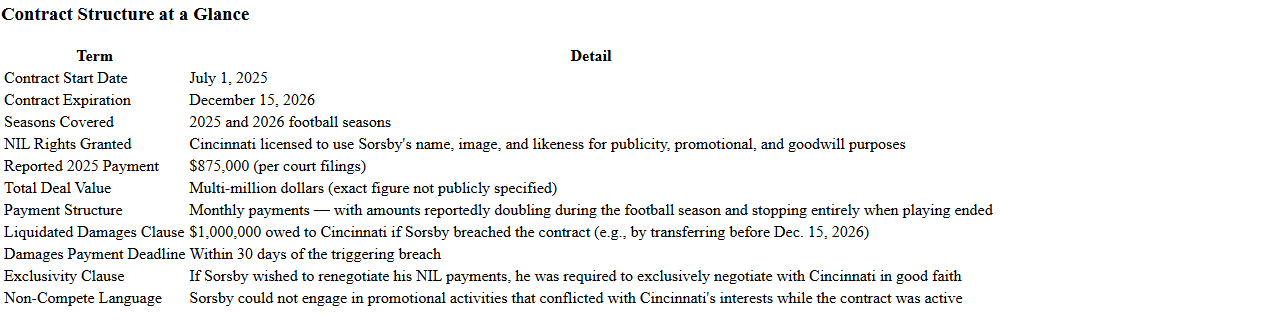
Cincinnati's position was straightforward: they paid Sorsby a substantial amount in 2025 with the expectation that the majority of the program's return on investment would come in 2026, after Sorsby's brand had grown and his performance had developed. The school viewed the $1 million liquidated damages clause as a good-faith estimate of the harm they would suffer if he left early, an estimate made in the summer of 2025 when, as the complaint noted, actual damages were "difficult to estimate" because the House settlement had just gone into effect and this type of direct school-to-athlete deal was brand new.
The Transfer and the Lawsuit
On December 1, 2025, Sorsby informed Cincinnati that he was done playing for the program. He declined to compete in the Bearcats' postseason Liberty Bowl game against Navy on January 2. That same day the portal opened, he entered it, and almost immediately committed to Texas Tech, reportedly signing an NIL deal with the Red Raiders worth between five and six million dollars for a single season.
The move had immediate consequences. Cincinnati alleged that by allowing Texas Tech to use his NIL on a large digital billboard in New York City's Times Square — celebrating his commitment to the Red Raiders, Sorsby violated the non-compete clause in his still-active Cincinnati agreement. The school's attorneys reminded Sorsby's agent of the $1 million liquidated damages obligation. His representative responded that Sorsby refused to pay anything.
On February 26, 2026, the University of Cincinnati filed a federal lawsuit against Sorsby in the U.S. District Court for the Southern District of Ohio. The school sought $1 million in liquidated damages and described the buyout as "significantly below market value" given the size of Sorsby's new Texas Tech deal. The case was assigned to U.S. District Judge Michael R. Barrett.
Sorsby Fires Back: The "Pay-for-Play" Defense
Sorsby did not quietly accept the lawsuit. His legal team, led by multiple high-profile attorneys, pushed back hard, and their argument cuts to the heart of what NIL is legally supposed to be.
Sorsby's lawyers argued that the Cincinnati contract was effectively a "pay-for-play" scheme dressed up in NIL language. His attorneys pointed to the payment structure as evidence: the monthly payments doubled during the football season and ceased entirely when he stopped playing. In their view, Cincinnati was not really paying for the use of Sorsby's name, image, and likeness, it was paying him to play football. That, they argued, makes the so-called NIL deal a legal fiction that should not be enforceable as written.
On the liquidated damages clause specifically, Sorsby argued it is unenforceable under Ohio law because it is excessive and unreasonable, effectively a penalty rather than a proportionate estimate of actual harm. His attorneys noted that the $1 million buyout exceeds what he was actually paid during the 2025 season ($875,000), which they characterized as disproportionate.
Sorsby also alleged that Cincinnati attempted to use the liquidated damages clause as leverage. According to his filings, the school offered to waive the damages provision entirely, but only if he entered the 2026 NFL Draft instead of transferring to a Big 12 rival like Texas Tech. His team argued this amounted to improper coercion, using an NIL contract as a competitive retention tool rather than a legitimate commercial licensing arrangement.
Finally, Sorsby contended he mitigated any damages by assisting Cincinnati in recruiting his own replacement, a quarterback who reportedly moved into his former apartment. Cincinnati added JC French, a redshirt senior from Georgia Southern, through the portal.
Cincinnati pushed back on all of it. The school cited an Ohio appellate precedent, Kent State's successful enforcement of a $1.2 million liquidated damages clause against a departing basketball coach, to argue that the $1 million figure was reasonable and enforceable. The university pointed out that one million dollars represents less than 50% of Sorsby's Cincinnati deal and a fraction of his new Texas Tech earnings, making the amount anything but excessive.
"Sorsby now seeks to avoid the consequences of his breaches of the Agreement and the promises he made to the University." — University of Cincinnati court brief, May 2026
As of the time of this writing, the breach-of-contract case remains active in federal court. No final ruling on the liquidated damages enforceability question has been issued, which means this case could set a landmark precedent for every NIL buyout clause in college athletics.
Then the Gambling Investigation Hit
While the Cincinnati lawsuit was working its way through the courts, a second and far more damaging story emerged: the NCAA's investigation into Sorsby's gambling history.
The findings were significant. According to court filings and reporting from ESPN and CBS Sports, Sorsby wagered approximately $90,000 on professional and college sports over four years. Investigators found he placed at least 2,900 bets totaling more than $30,000 during his two years at Indiana and at least 165 bets totaling more than $38,000 during his two seasons as Cincinnati's starter. In total, the betting spanned more than 9,000 individual wagers, an average of roughly 20 bets per day over parts of his college career. He also sent money to family members and friends to place bets on his behalf, including after arriving at Texas Tech.
The most serious violation under NCAA rules was this: Sorsby placed at least 40 bets on Indiana football while he was a member of that program as a redshirt freshman in 2022. Under NCAA regulations, any athlete who wagers on their own team or school faces permanent loss of eligibility. There are no second chances built into that rule.
The NCAA ruled Sorsby permanently ineligible. Texas Tech appealed on his behalf. The appeal was denied. In late April 2026, Sorsby announced he would enter a residential treatment facility for gambling addiction, a step his head coach, Joey McGuire, publicly supported. After several weeks of treatment, Sorsby returned home before traveling back to Lubbock.
The Injunction: A Court Overrules the NCAA
Sorsby's legal team, led by Jeffrey Kessler, the same attorney who negotiated the historic House v. NCAA settlement, filed for a preliminary injunction to allow Sorsby to play for Texas Tech while his lawsuit against the NCAA worked through the court system. The argument centered on irreparable harm: if Sorsby could not play in 2026, he would lose access to elite-level training, jeopardize his ability to enter the 2026 NFL Supplemental Draft, and potentially forfeit tens of millions of dollars in career earnings.
On June 9, 2026, Judge Ken Curry of the 99th District Court in Lubbock County issued a ruling that sent shockwaves through college athletics. Curry sided with Sorsby, finding that he would suffer "probable, imminent, and irreparable injury" if prevented from playing while the case proceeded. The NCAA was enjoined from prohibiting Sorsby from practicing, playing, or participating on Texas Tech's football team for the 2026 season. Sorsby will serve a two-game suspension to open the year — a penalty his own attorneys had previously proposed, but is otherwise eligible to play.
The NCAA was direct in its response:
"The NCAA strongly disagrees with the court's ruling in Sorsby's case and is deeply concerned about the damaging, far-reaching and broadly destabilizing ramifications of this outcome — which undermines and corrupts the integrity of sports." — NCAA Statement, June 2026
Texas Tech athletic director Kirby Hocutt called the ruling the right outcome and pledged that a comprehensive support structure, including clinical care, monitoring, and compliance checks, would remain in place throughout Sorsby's time on campus.
Notably, NCAA officials referenced the Protect College Sports Act in connection with this ruling — arguing that the pending federal legislation would empower the NCAA to enforce rules like its gambling restrictions more effectively. The Sorsby case has now become a public argument for why Congress needs to act.
The Financial Picture: What Is Actually at Stake
To understand the full weight of the Sorsby situation, you have to look at the numbers in one place:
Cincinnati NIL payment (2025): $875,000
Cincinnati liquidated damages owed: $1,000,000 (disputed, case pending)
Texas Tech NIL deal (2026): Reported at $5–6 million for one season
Texas Tech's total 2026 roster valuation: $38.1 million — with Sorsby as the anchor
Estimated NFL earnings at risk: $7 million to $22 million depending on draft position, if the gambling situation damages his draft stock or ends his career entirely
Total potential financial exposure: Analysts have placed the figure north of $25 million
This is what happens when an athlete signs a multimillion-dollar contract without fully understanding its terms, when the gambling landscape in college sports goes unaddressed, and when the legal framework around NIL is still being written in real time. Every single dollar in that list is either at risk, in dispute, or already spent.
PSG's Take: What We Think About All of This
We are going to be direct here, because that is what athletes deserve.
On the Cincinnati Contract
The payment structure Sorsby described, monthly payments doubling during football season and stopping the moment he stopped playing is an examples of what we call a masked pay-for-play contract. NIL deals are supposed to compensate athletes for the commercial value of their name, image, and likeness. The moment the payments become performance-contingent and football-schedule-dependent, the commercial licensing rationale starts to fall apart, and the legal exposure for the athlete goes up dramatically.
That said, Sorsby signed it. And the Cincinnati argument has real legal legs, especially given Ohio case law on liquidated damages. The court will ultimately decide whether $1 million is a reasonable pre-estimated harm or an unenforceable penalty. But here is the athlete education lesson: if you cannot explain what you are being compensated for in your NIL deal without mentioning football, a red flag is waving.
On the Transfer Situation
The Times Square billboard moment is a detail that should not be glossed over. Sorsby, or his camp, allowed Texas Tech to publicly use his NIL before his Cincinnati contract expired. That is a direct breach of a non-compete clause, and it is the kind of mistake that a contract-literate agent should have caught immediately. When you are under an active NIL agreement, your image does not become free game the moment you decide to leave. Your obligations run until the contract says they end.
On the Gambling Issue
This is where we want to be careful but honest. Gambling addiction is a real medical condition, and Sorsby made the right call by seeking professional treatment. We are genuinely glad he did that. But the NCAA gambling rule exists for a reason that goes to the foundation of athletic competition itself: if an athlete is placing bets on their own team's games, the integrity of every play, every decision on the field, is in question. No court injunction changes that underlying concern. The NCAA's rule is one of the clearest and most longstanding in college sports, and courts overriding it through injunction, while legally available, sets a precedent that should make everyone in college athletics think carefully about what comes next.
From an athlete education standpoint: the NCAA's gambling rules are not ambiguous. They do not have exceptions for addiction. Athletes need to understand them clearly, ideally before they ever set foot on a college campus. This is not something you learn about after you are already in trouble.
On the Broader NIL Landscape
The Sorsby case sits alongside the Darian Mensah situation at Duke, the Demond Williams Jr. standoff at Washington, and a growing list of disputes that all point to the same truth: NIL contracts are now functioning like employment contracts in all but name. Schools are enforcing buyout clauses. Courts are being asked to rule on the relationship between NIL licensing and competitive retention. The House v. NCAA settlement opened the door for direct athlete payments, and now both schools and athletes are learning, sometimes the hard way, exactly what they agreed to.
This is not a reason to avoid NIL deals. It is a reason to understand them before you sign them.
Red Flags Athletes Should Watch for in NIL Contracts
The Sorsby contract, as described in court filings, contained several terms that athletes and their families should know to scrutinize before signing any agreement:
Performance-contingent payments: If your NIL payments increase or stop based on whether you are actively playing, ask whether this is truly an NIL deal or a thinly-veiled pay-for-play arrangement.
Liquidated damages clauses: Understand exactly what amount you owe if you breach the contract, when it becomes due, and what events trigger it. A $1 million exit fee is not unusual in today's market — but it should not come as a surprise.
Non-compete and exclusivity provisions: Know what you cannot do while the contract is active. Allowing another school to use your NIL in a public advertising campaign before your current deal expires can constitute a breach.
Exclusive renegotiation clauses: If the contract says you must negotiate any raise exclusively with the school in good faith, you have given up the right to shop your value to outside parties during that window.
Term and expiration dates: Multi-year contracts do not automatically dissolve when you decide you are ready to leave. Know the end date and what it costs to exit early.
What Athletes and Families Should Do Now
The Sorsby story is not an outlier. It is a preview of where college athletics is heading. As direct school-to-athlete payments become standard and NIL deal values continue to climb, the contracts being placed in front of athletes are going to look more and more like professional sports agreements — with all the complexity and all the consequences that come with them.
Here is what we recommend:
Never sign an NIL agreement without having it reviewed by someone who understands NIL contract law. This is not a form letter. It is a binding legal document.
Know the NCAA's gambling rules before you ever place a bet. They apply the moment you are a college athlete. They do not have a mental health exception built in. Courts may intervene, but the process is expensive, exhausting, and uncertain.
Understand your obligations before you enter the transfer portal. Announcing your intention to transfer does not automatically void your NIL contract. In fact, it may trigger its most expensive clause.
Ask hard questions about payment structures. Why do my payments double during football season? What happens to my NIL payment if I get injured? These questions matter.
The Bottom Line
Brendan Sorsby is a talented quarterback who, at 22 years old, is now simultaneously a defendant in a federal contract lawsuit, a plaintiff in an NCAA eligibility case, and a recovery patient managing a gambling disorder, all while trying to prepare for a college football season and protect a professional career that could be worth tens of millions of dollars. None of that had to happen all at once. Better contract literacy, earlier awareness of the NCAA's gambling rules, and professional guidance before signing would not have guaranteed a different outcome, but they would have given him a fighting chance to make informed decisions at every step.
That is what athlete education is for. That is exactly what we do at Pannell Sports Group.
Work With Pannell Sports Group
The Sorsby case is complicated. Your NIL deal does not have to be. At Pannell Sports Group, we specialize in helping college athletes, high school recruits, and their families understand NIL agreements before they sign, so you know exactly what you are agreeing to, what it costs to leave, and how to protect your brand and your future.
Whether you are reviewing your first NIL contract, navigating a transfer, or trying to understand what the latest court decisions mean for your situation, we are here to help. Visit us at pannellsportsgroup.com to schedule a consultation. Your name, image, and likeness are worth protecting, let us help you do it right.
Sources
Schlabach, Mark. "Cincinnati sues Sorsby over $1M exit fee after Texas Tech transfer." ESPN, February 25, 2026. espn.com
"Cincinnati Sues Ex-QB Sorsby as NIL Nudges Toward Employment." Sportico, February 26, 2026. sportico.com
"Brendan Sorsby, Amid Gambling Treatment, Argues Against NIL Deal." Sportico, April 29, 2026. sportico.com
"Brendan Sorsby Sues NCAA, Is Being Sued by Cincinnati & Could Sue NFL." Sportico, May 2026. sportico.com
"Brendan Sorsby granted injunction vs. NCAA, eligible to play in 2026." ESPN, June 9, 2026. espn.com
"Brendan Sorsby granted 2026 eligibility: Texas Tech QB wins injunction vs. NCAA amid gambling probe." CBS Sports, June 9, 2026. cbssports.com
"Texas Tech Already Promised Brendan Sorsby $6M NIL Before Ruling QB Ineligible." Yahoo Sports, May 2026. sports.yahoo.com
"Brendan Sorsby might lose $25.4M in earnings due to gambling." Yahoo Sports, June 2026. sports.yahoo.com
"University of Cincinnati Is Testing the Limits of Liquidated Damages in NIL Case." Sports Litigation Alert. sportslitigationalert.com
"Cincinnati sues former quarterback Brendan Sorsby over $1M NIL buyout after Texas Tech transfer." Fox News, February 26, 2026. foxnews.com
"Lubbock judge blocks NCAA permanent ban of Texas Tech quarterback Brendan Sorsby." FOX 4 Dallas-Fort Worth, June 9, 2026. fox4news.com
"Cincinnati opposes Sorsby's dismissal request in NIL lawsuit." The Daily Toreador, May 22, 2026. dailytoreador.com
This blog post is intended for educational purposes only and does not constitute legal or financial advice. Parents and student-athletes should consult a licensed attorney and/or financial professional before entering any NIL agreement.