Revenue Sharing Explained: How Much Can College Athletes Actually Make Now?
For decades, college athletes generated billions of dollars in revenue for their schools, and received none of it. That era is over.
As of July 1, 2025, the House v. NCAA settlement officially went into effect, allowing Division I schools to share revenue directly with their athletes for the first time in the history of college sports. Combined with NIL, college athletes now have more earning potential than ever before.
But how much are athletes actually making? Who gets the most? What is the difference between revenue sharing and NIL? And what does any of this mean for you?
This is your complete, plain-language breakdown.
What Is Revenue Sharing?
Revenue sharing is direct payment from your school to you, separate from your scholarship, and separate from any NIL deal you sign with a brand.
Before July 2025, schools were not allowed to pay athletes directly beyond scholarships. The House settlement changed that by requiring the NCAA and Power conferences to pay $2.8 billion in back damages to approximately 184,000 former Division I athletes, while simultaneously opening the door for schools to begin sharing revenue with current athletes going forward.
Think of it this way. You now have three potential income streams as a college athlete:
Revenue share — direct payment from your school
Commercial NIL — brand deals you sign independently (endorsements, sponsorships, social media)
Collective NIL — payments from booster-backed collectives (though these are now under stricter scrutiny)
All three are real. All three vary significantly by sport, school, and athlete. And understanding the difference between them could be the most important financial move you make as a college athlete.
How Much Can Schools Pay? The $20.5 Million Cap
Every participating Division I school is allowed but not required, to share up to $20.5 million per year with its athletes in the 2025-26 academic year. That figure represents 22% of the average revenue generated by Power conference schools from media rights, ticket sales, and sponsorships.
Importantly, that cap is not permanent. It is set to grow by at least 4% annually, with projections reaching approximately $33 million per school by 2035.
Every Power 4 school, all 68 universities across the SEC, Big Ten, Big 12, and ACC, has committed to distributing the full $20.5 million. At schools outside the Power 4, participation varies, and some programs share significantly less.
The key word in all of this: allowed. The school decides how much to pay and how to distribute it. There is no universal formula. This is where the gap between athletes grows wide.
Who Gets the Money? The Sport-by-Sport Breakdown
Not every athlete at a school receives the same amount, or anything at all. Schools have broad discretion to allocate their pool however they choose. Here is how the money typically breaks down:
Football: The Dominant Share
Football receives the largest slice at most programs, roughly 75% of the total revenue share pool, or approximately $15.4 million of the $20.5 million cap. This reflects football's role as the primary revenue engine at virtually every major athletic department.
With FBS roster limits now set at 105 players, that $15.4 million spread across a full roster averages out to roughly $146,000 per player, though in practice, top players receive substantially more and depth players receive less. Schools are not required to distribute equally.
When you layer in commercial NIL deals and collective arrangements on top of revenue sharing, college football players are projected to earn $1.9 billion collectively in 2025, according to Opendorse, nearly double what the sport generated in 2024. That figure is expected to climb to $2.4 billion in 2026 and $2.6 billion in 2027.
Men's Basketball: The Highest Per-Player Average
Men's basketball programs typically receive 10-15% of the revenue share pool, or roughly $2 million to $3.75 million. On the surface, that is far less than football. But here is the key: basketball rosters are much smaller, usually 13 to 15 scholarship players.
That smaller roster means the per-player average in men's basketball is actually higher than football at most schools. Elite program players are seeing some of the largest individual revenue-share payments in college sports.
Women's Basketball — Growing Fast
Women's basketball typically receives 5-10% of the pool, or $1 million to $2 million per program. The rise of stars like Caitlin Clark has dramatically accelerated investment in women's basketball NIL and commercial partnerships. Women's sports athletes across all sports are projected to earn a combined $417.8 million in 2025, with that figure expected to surpass $663 million by 2028.
Other Sports — Baseball, Softball, Volleyball, Gymnastics, and More
Athletes in non-revenue sports, baseball, softball, volleyball, gymnastics, swimming, track, soccer, and others, receive whatever remains after football and basketball take their share. At most schools, this is a modest amount that varies widely by program investment and sport.
However, there is a notable counterbalance: roughly 90% of new NCAA scholarship award opportunities being created under the post-settlement framework are targeted at non-revenue sport athletes, offsetting some of the revenue-share gap with academic funding.
Non-revenue sport athletes also retain their full ability to pursue commercial NIL deals independently, and that market is growing.
Revenue Sharing vs. NIL: What Is the Difference?
This is the question families and athletes ask most often, and the confusion is understandable.
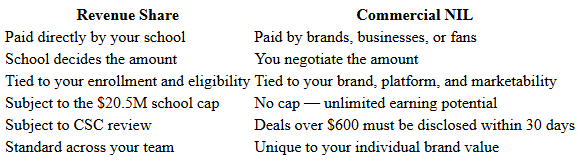
The critical insight here: revenue sharing and NIL are additive, not exclusive. You can earn both. Your school's revenue share payment does not reduce what you can earn through commercial NIL deals. The top earners in college sports are maximizing both streams simultaneously.
What About Collectives?
Booster collectives, organizations funded by alumni and fans to pay athletes through NIL arrangements, dominated the compensation landscape from 2021 through 2024. At their peak in 2024, collectives generated close to One-Billion in athlete payments.
More importantly, the Protect College Sports Act (PCSA), currently moving through the Senate, would prohibit collective NIL payments that do not represent legitimate, fair-market-value transactions. Deals structured as NIL but functioning as pay-for-play or cap evasion would be banned.
The collective era is not over, but it is transforming. Collectives that offer authentic, market-value NIL opportunities will survive. Those that have operated as disguised recruitment or retention tools are on borrowed time.
What Does "Fair Market Value" Mean for Your NIL Deal?
This is one of the most consequential concepts athletes need to understand right now.
Under the House settlement framework and the proposed PCSA, NIL deals, including collective arrangements, are subject to review by the College Sports Commission (CSC) to ensure they reflect genuine market value. A deal that pays an athlete $500,000 for a social media post that a comparable non-athlete influencer would earn $10,000 for could be flagged as disguised pay-for-play.
The NCAA and CSC are building an anonymized NIL database specifically to establish market benchmarks by sport, school, follower count, and deal type. Every legitimate deal you sign contributes to that picture, and every deal you sign will be measured against it.
The practical lesson: build a real brand. Athletes with authentic social followings, community presence, and genuine commercial appeal will consistently clear fair-market-value thresholds. Athletes whose only NIL income comes from inflated collective arrangements are exposed to the most risk as enforcement tightens.
What Should Athletes Do With This Information?
Understanding revenue sharing is not just an academic exercise. It changes how you approach recruiting, transfers, and your overall college career strategy. Here is what smart athletes are doing right now:
Ask every program directly how they distribute revenue share. There is no standard formula. Some schools front-load payments to starters. Some distribute more evenly. Some reserve a larger portion for basketball. You have the right to ask, and the answer should factor into your decision.
Do not confuse revenue share with total earning potential. A school offering a large revenue-share payment is not necessarily the best NIL environment. Commercial NIL, which depends on your brand, market, and platform — can exceed your school payment if you build it strategically.
Treat revenue sharing as your floor, not your ceiling. The athletes who maximize this era are not relying solely on what their school decides to pay them. They are building commercial value that exists independently of any institution.
Get your financial house in order now. Revenue sharing income is taxable. All NIL income is taxable. With the new $600 disclosure threshold on NIL deals, the era of informal, untracked athlete payments is over. Work with an advisor who understands athlete compensation, not just general tax advice.
Build your brand before you need it. The college athletes earning the most in commercial NIL are not the ones who started building after they arrived on campus. They are the ones who built a platform before enrollment and leveraged it the moment NIL rights kicked in.
The Bottom Line
College athletes can earn real, significant income today, through revenue sharing, commercial NIL, and legitimate collective arrangements. The question is no longer whether you can get paid. The question is whether you are positioned to earn what you are worth.
The athletes who win in this environment are the ones who treat their name, image, and likeness like a business, building authentic brands, understanding the rules, asking the right questions during recruiting, and working with people who know how to navigate the landscape.
That is exactly what Pannell Sports Group is built to help you do.
Sources & Further Reading
Front Office Sports — College Hoops and Revenue Sharing Breakdown
Sports Illustrated — College Football NIL Surges Toward $2 Billion
Pannell Sports Group publishes ongoing guidance on NIL, revenue sharing, and athlete career strategy. Follow us for the latest updates and subscribe to our newsletter for in-depth breakdowns delivered directly to your inbox.
Tags: college athlete revenue sharing, House v NCAA settlement, NIL deals 2026, how much do college athletes make, college football NIL money, revenue sharing explained, college athlete compensation, NIL vs revenue sharing, Power 4 athletics, Pannell Sports Group
This blog post is intended for educational purposes only and does not constitute legal or financial advice. Parents and student-athletes should consult a licensed attorney and/or financial professional before entering any NIL agreement.